
The History of Windward Avenue
For more than a century, Windward Avenue has been the front door to Venice Beach. It has been a resort promenade, a Prohibition hideaway, a film set, a gathering place for poets, musicians and skaters, and today one of the most recognizable streets in Los Angeles. Here is how the street, its landmarks and its businesses have evolved, chapter by chapter.
On July 4, 1905, developer Abbot Kinney opened “Venice of America,” a seaside resort modeled on Venice, Italy. Crews had spent 1904 digging canals with mule teams and steam shovels, and Windward Avenue became the resort’s grand main street, running from the lagoon to the ocean.
The street was designed to feel Italian. Arched arcades covered the sidewalks on both sides, supported by ornamental columns with classical faces designed by artist Felix Peano. A miniature railway carried visitors along Windward, and Kinney hung the original VENICE sign to announce his new city.
Photo: The arcade of the St. Mark’s Hotel on Windward Avenue, ca. 1906. California Historical Society Collection, USC Libraries. Public domain.
1905: Venice of America
At the ocean end of Windward, on the corner of Ocean Front, stood the St. Mark’s Hotel, which opened with the resort on July 4, 1905. Built in an Italian style to match Kinney’s vision, with thick walls and arched ground-floor arcades, it was the grandest address on the street.
The hotel anchored Windward Avenue for more than half a century. It was torn down in the 1960s, when city planners were pursuing beachfront parking, and the site became a parking lot.
Photo: The St. Mark’s Hotel on Windward Avenue at Ocean Front, ca. 1905. California Historical Society Collection, USC Libraries. Public domain.
The St. Mark’s Hotel
Windward Avenue ended at Kinney’s pier, with its auditorium, dance hall and amusements. Its most famous landmark was the Ship Cafe, a restaurant built to resemble Juan Rodríguez Cabrillo’s galleon San Salvador and set on concrete pilings beside the pier.
First opened in 1904 and rebuilt after a storm washed it away in March 1905, the Ship Cafe drew Hollywood stars including Charlie Chaplin, Fatty Arbuckle and Jack Dempsey. It burned with the pier in 1920, was rebuilt in 1921, and survived until the Venice pier complex was demolished in 1946.
Photo: The Venice Pavilion and Ship Cafe, ca. 1905–1913. California Historical Society Collection, USC Libraries. Public domain.
The Ship Cafe and the Pier
By 1910 Venice had around 3,100 residents, but on weekends 50,000 to 150,000 visitors poured in. Pacific Electric trolleys ran along Trolleyway, today’s Pacific Avenue, and crowds climbed the wide steps from the lagoon up to Windward.
On Windward in the 1910s
City directories list a street full of hotels, banks and shops: the Windward Hotel and Hotel Berlin; the Hotel Gondolier at 28 Windward; the Hotel Venice and the Venice Turkish Baths at 26 Windward; Venice Hardware Co. at 18 Windward; the First National Bank of Venice and Venice Savings Bank at Windward and Trolleyway; and Venice Drug Co. on the Ocean Front corner. In 1915, Italian immigrant Cesar Menotti opened Menotti’s Buffet at 52 Windward Avenue, today the oldest bar in Venice.
Photo: Crowds on the steps between the lagoon and Windward Avenue, postcard postmarked 1909. Newman Post Card Co., USC Libraries Special Collections. Public domain.
1910s: The Resort Years
Abbot Kinney died in November 1920, and on December 20 fire destroyed the pier. It reopened in 1921 as the Venice Amusement Pier. During Prohibition, Menotti’s became a speakeasy, using the steam tunnels beneath Venice to move bootleg liquor.
In 1925 residents voted to consolidate with Los Angeles, and Venice was annexed in 1926. On July 1, 1929, the city began filling the canals to make way for automobiles. The lagoon at the head of Windward became a traffic circle, today’s Windward Circle, and oil was discovered in south Venice that same year.
Photo: Windward Avenue seen from the lagoon, now Windward Circle, early 1900s postcard. USC Libraries Special Collections. Public domain.
1920s: Fire and Prohibition
The discovery of oil in 1929 transformed south Venice almost overnight. Within two years some 450 wells covered the area, and drilling waste clogged the remaining canals. Through the Great Depression, low rents drew European immigrants, artists and radicals; Upton Sinclair kept an office on nearby Market Street during his run for governor.
In 1939 the federal government built the Venice Post Office on Windward Circle, and in 1941 artist Edward Biberman painted its lobby mural, “Abbot Kinney and the Story of Venice,” showing Kinney framed by his canals and a wooden roller coaster. In 1942, Japanese American families from Venice were forced from their homes and incarcerated, many at Manzanar. When the tidelands leases expired in 1946, the city closed and demolished the amusement piers at the foot of Windward, ending the resort era.
Photo: Edward Biberman’s mural in the lobby of the Venice Post Office on Windward Circle, 1941. U.S. Treasury Department Section of Painting and Sculpture. Public domain.
1930s–40s: Hard Times
By the 1950s Venice was known as “the Slum by the Sea.” Pacific Electric passenger service ended in 1950, Pacific Avenue was finally paved in 1954, and Kinney’s original VENICE sign disappeared from Windward. Cheap rents made Venice a haven for poets and painters: the Venice West Café opened on the beachfront in 1958, the Gas House on Ocean Front Walk became a Beat gathering place, and Lawrence Lipton’s 1959 book The Holy Barbarians turned Venice into a destination for beatnik tourists. The city condemned the Gas House in 1962.
In 1958, Orson Welles filmed Touch of Evil on Windward Avenue between Pacific Avenue and Speedway, using its weathered arcades to stand in for a Mexican border town.
Photo: Camera operator Philip H. Lathrop, Charlton Heston and Orson Welles on the set of Touch of Evil, 1957. Universal Pictures publicity still. Public domain.
1950s: Beats and Hollywood
In 1961 the city built the Venice Pavilion on the beach at the foot of Windward. In 1965, Jim Morrison and Ray Manzarek formed The Doors in Venice, and the band’s sound and Morrison’s legend became forever tied to the neighborhood. That same year, on August 25, 1965, Joe Gold opened Gold’s Gym in Venice, which would become known as “the Mecca of bodybuilding.”
The decade also brought loss. The Venice West Café closed in 1966, and the St. Mark’s Hotel, once the grandest address on Windward, was torn down as the city pursued beachfront parking.
Photo: The Doors in a 1966 publicity photo by Joel Brodsky. Public domain, via Wikimedia Commons.
1960s: Rock and Iron
The 1970s made Venice a world capital of beach culture. Harry Perry began playing electric guitar on roller skates on the Boardwalk in 1973. The Zephyr team’s “Dogtown” skaters from Venice and Santa Monica reinvented skateboarding, dominating the 1975 Del Mar Nationals. On July 4, 1976, Cheapskates opened the first roller-skate rental on Venice Beach, and the Boardwalk became known as the roller skating capital of the world.
In 1977 the documentary Pumping Iron, filmed largely at Gold’s Gym in Venice, introduced bodybuilding and Arnold Schwarzenegger to a wide audience. On Windward itself, Terry Schoonhoven painted the St. Charles Painting mural in 1979, and that same year Hama Sushi opened on Windward, where it still serves today.
Photo: A bodybuilder on stage at Muscle Beach Venice, 2008. Photo by Lin Mei, CC BY 2.0, via Wikimedia Commons.
1970s: Skate Culture
In the 1980s and 1990s, the Boardwalk at the foot of Windward became a world-famous stage for street performers, artists and vendors. From 1980 on, the abandoned Venice Pavilion’s sunken concrete basin, known as the Pit, became a hub for skateboarders, breakdancers, graffiti artists and punk rockers, and is regarded as a birthplace of street skating.
Muralists kept adding to Windward: in 1989 Rip Cronk painted Venice Reconstituted, his roller-skating take on Botticelli’s Birth of Venus, at Windward and Speedway. The Venice canals were listed on the National Register of Historic Places in 1982 and restored in 1993, and the last oil wells near the Pavilion were capped in 1991. The Pavilion was torn down in 1999; its walls were preserved as the Venice Art Walls, where painting is legal, and in 2009 the Venice Beach Skatepark opened on the site of the Pit.
Photo: Ocean Front Walk, Venice, 1985. John Margolies Roadside America photograph archive, Library of Congress. No known restrictions on publication.
1980s–90s: Boardwalk Era
As Venice approached its centennial, an effort led by former Venice Heritage Museum president Todd von Hoffmann recreated Abbot Kinney’s sign. The new VENICE sign, with 33-inch aluminum letters lit by LEDs and stretching 63 feet across, was hung in 2007 over Windward and Pacific Avenues on the original anchors. The Venice Chamber of Commerce has cared for it ever since, and in 2012 the Touch of Venice mural on Windward commemorated the street’s role in film history.
Photo: The VENICE sign over Windward and Pacific Avenues, 2014. Photo by glwx, CC BY-SA 3.0, via Wikimedia Commons.
2007: The Sign Returns
Beneath the Venice sign, Windward Avenue has become one of the most sought-after event settings in Los Angeles, from the annual holiday sign lighting to The Doors’ 50th anniversary, the Los Angeles Rams’ welcome home, Tommy Hilfiger’s Tommyland with Gigi Hadid, and Dior’s runway with Venice designer Eli Russell Linnetz. See events on Windward.
What’s next for Windward
Ahead of the 2028 Olympics, the Venice Neighborhood Council is reviewing concepts to reshape the street: turning the block between Speedway and Pacific into a pedestrian plaza, and redesigning the block between Pacific and Windward Circle as a plaza-like space with one westbound traffic lane.
The Windward Ave Association carries this history forward, representing the businesses, property owners, residents and neighbors of the street, serving as its through line to the City of Los Angeles, and making sure Windward Avenue’s next chapter works for everyone who shares it. Get in touch.
Today and Tomorrow
Windward Through the Years
More photographs of Windward Avenue and Venice, from the resort era to the Boardwalk. Click any image to enlarge it.
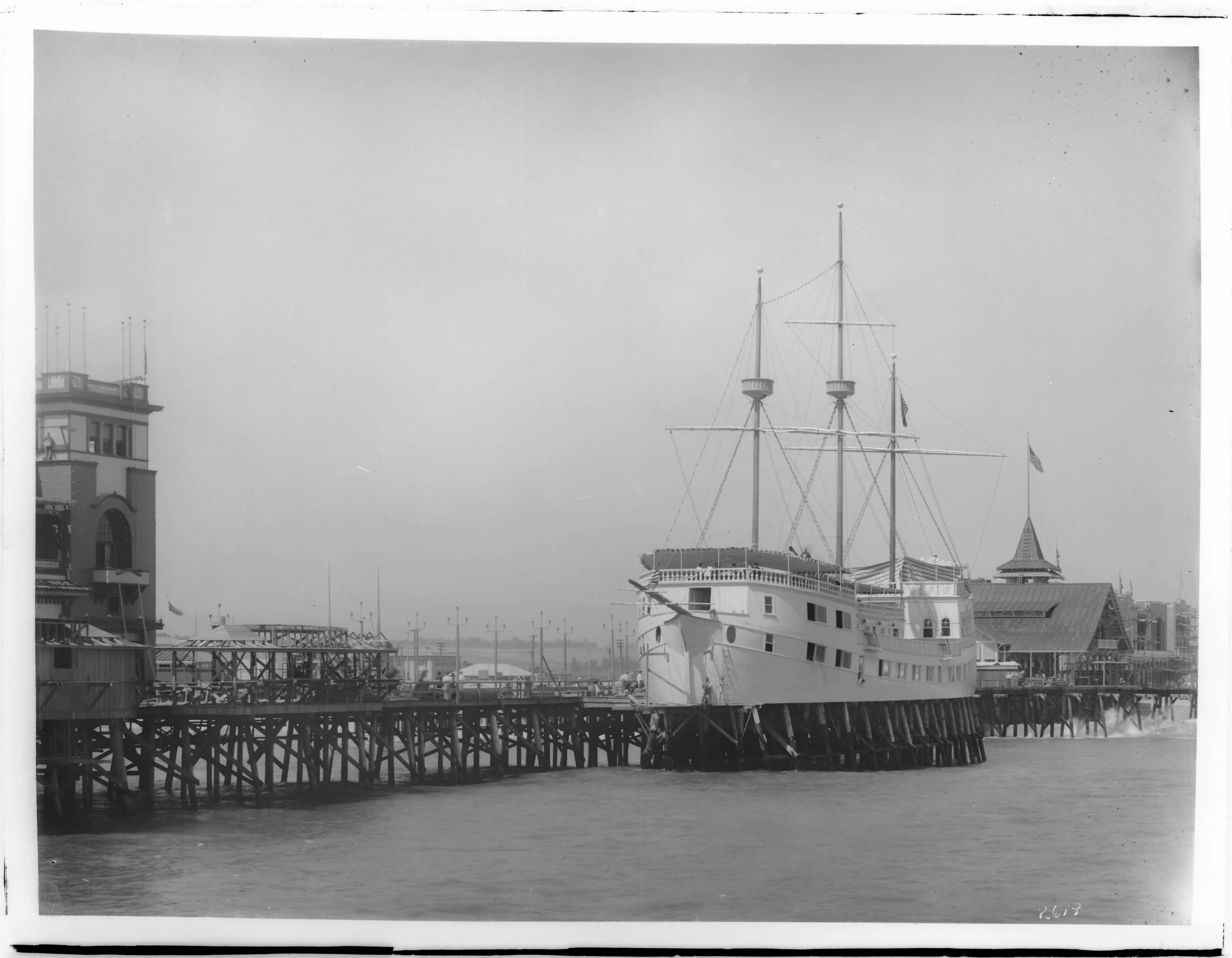
The Ship Cafe and Venice Wharf, ca. 1905. California Historical Society Collection, USC Libraries. Public domain.
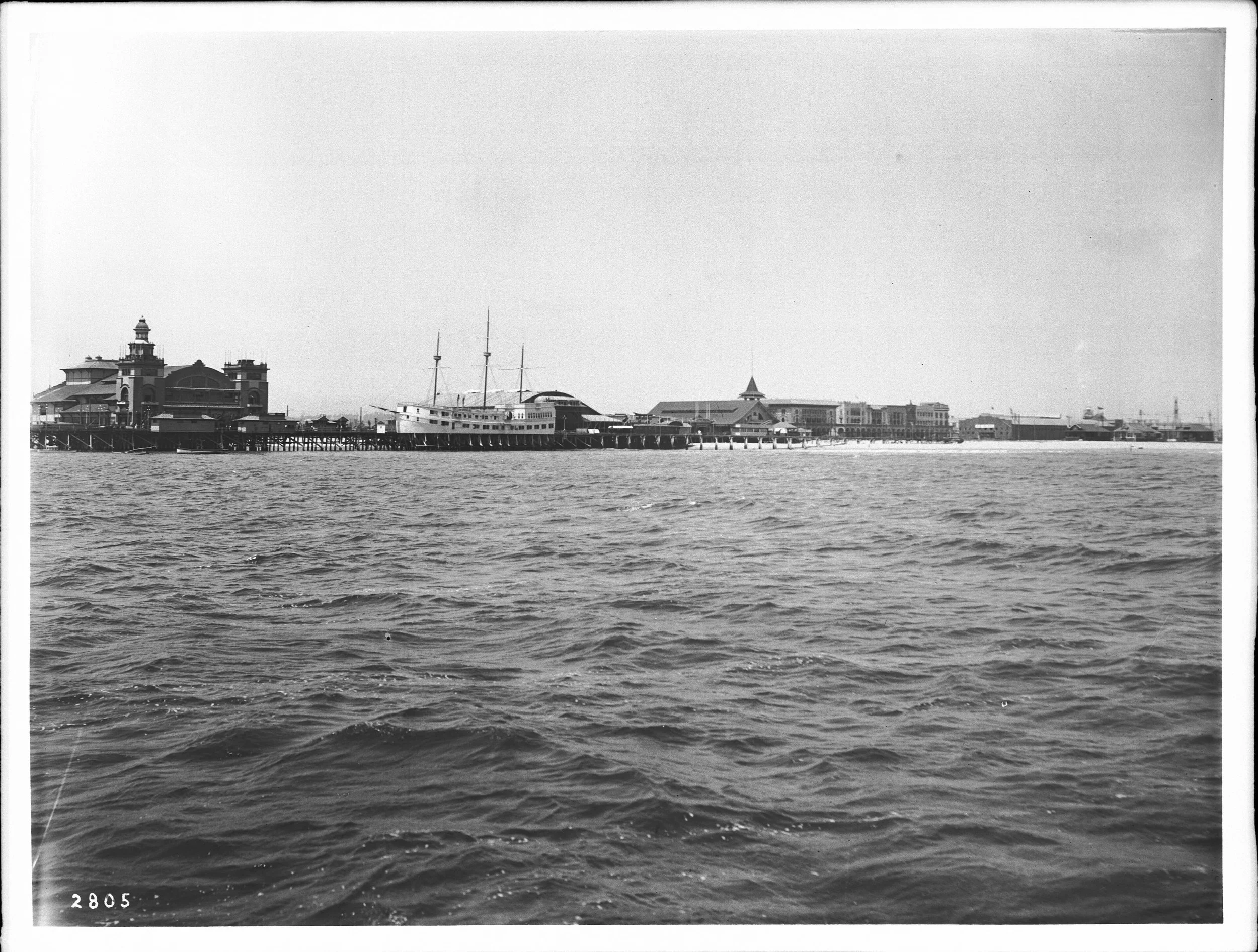
Kinney's pier and the Venice Pavilion seen from the ocean, ca. 1905. California Historical Society Collection, USC Libraries. Public domain.
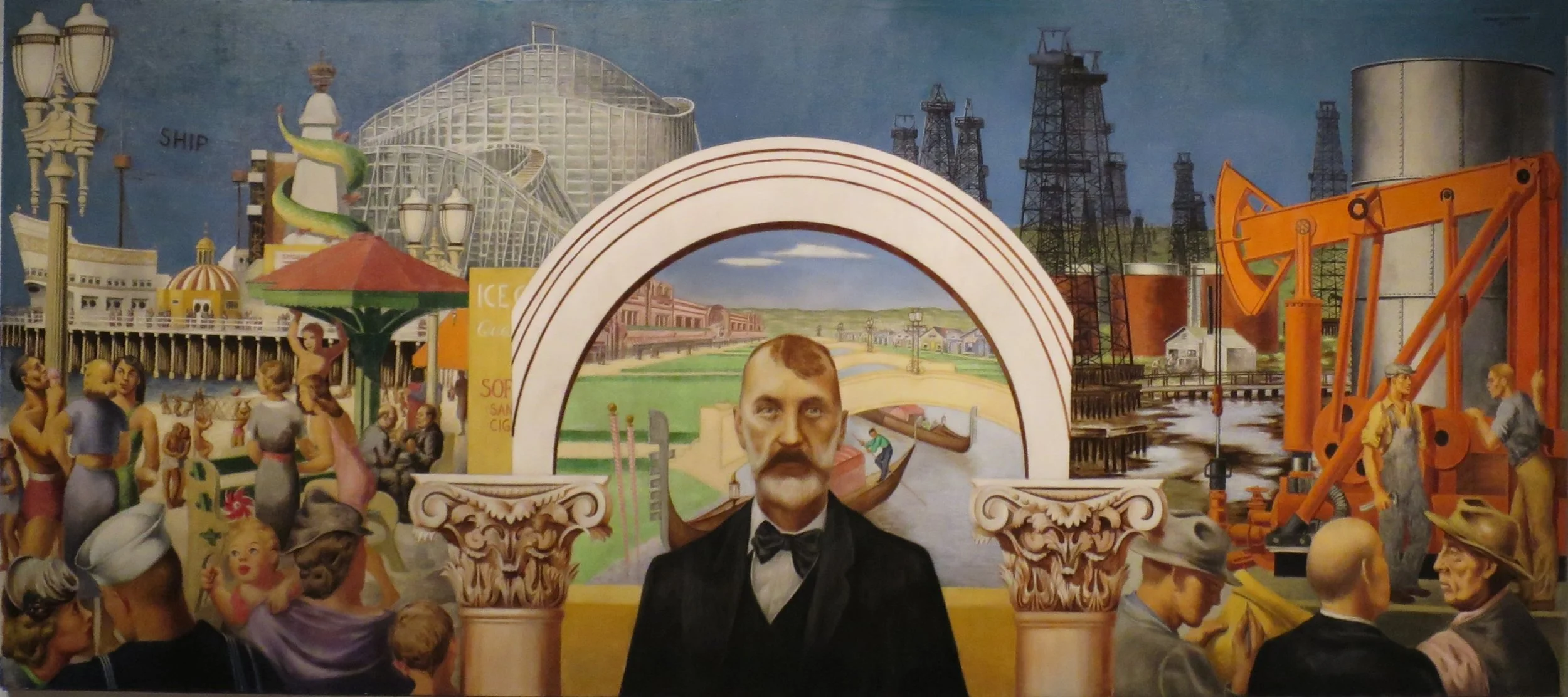
Detail of Edward Biberman's 1941 mural "Abbot Kinney and the Story of Venice," painted for the Venice Post Office on Windward Circle. U.S. Treasury Department commission. Public domain.
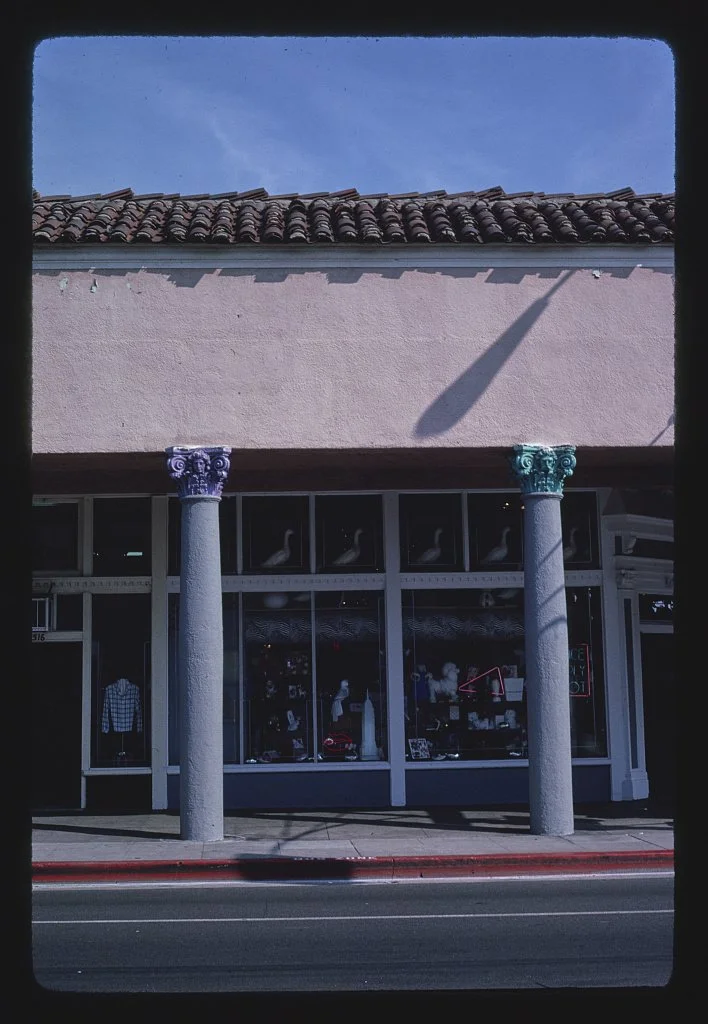
Surviving Venice of America columns, 1985. John Margolies Roadside America photograph archive, Library of Congress. No known restrictions on publication.
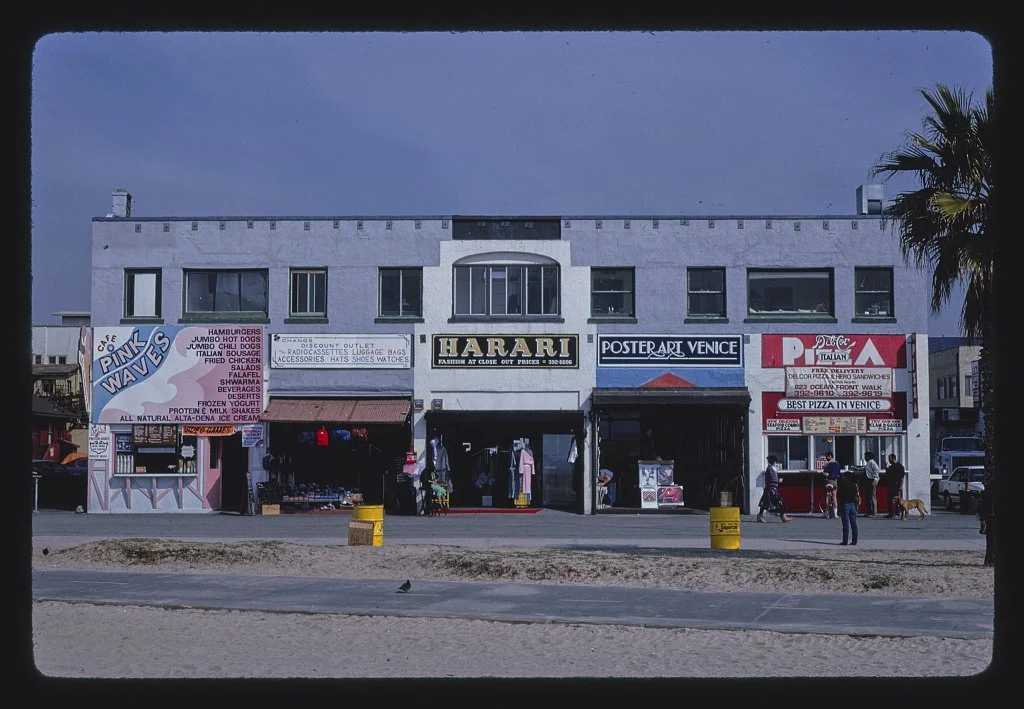
Shops on Ocean Front Walk, 1985. John Margolies Roadside America photograph archive, Library of Congress. No known restrictions on publication.
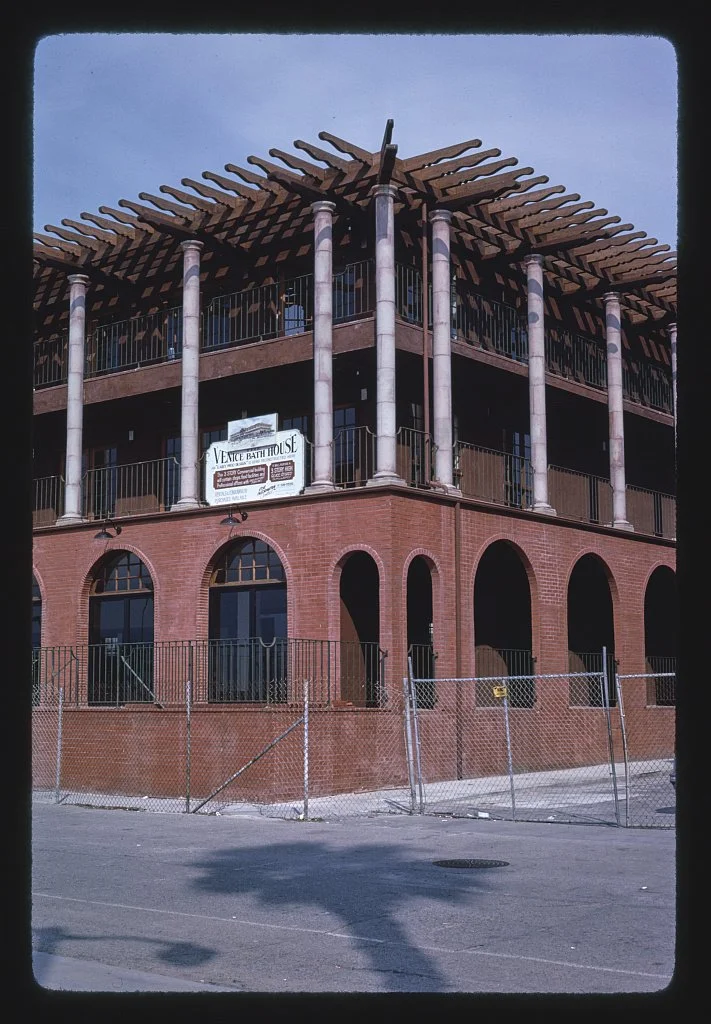
The Venice Bath House building, 1985. John Margolies Roadside America photograph archive, Library of Congress. No known restrictions on publication.
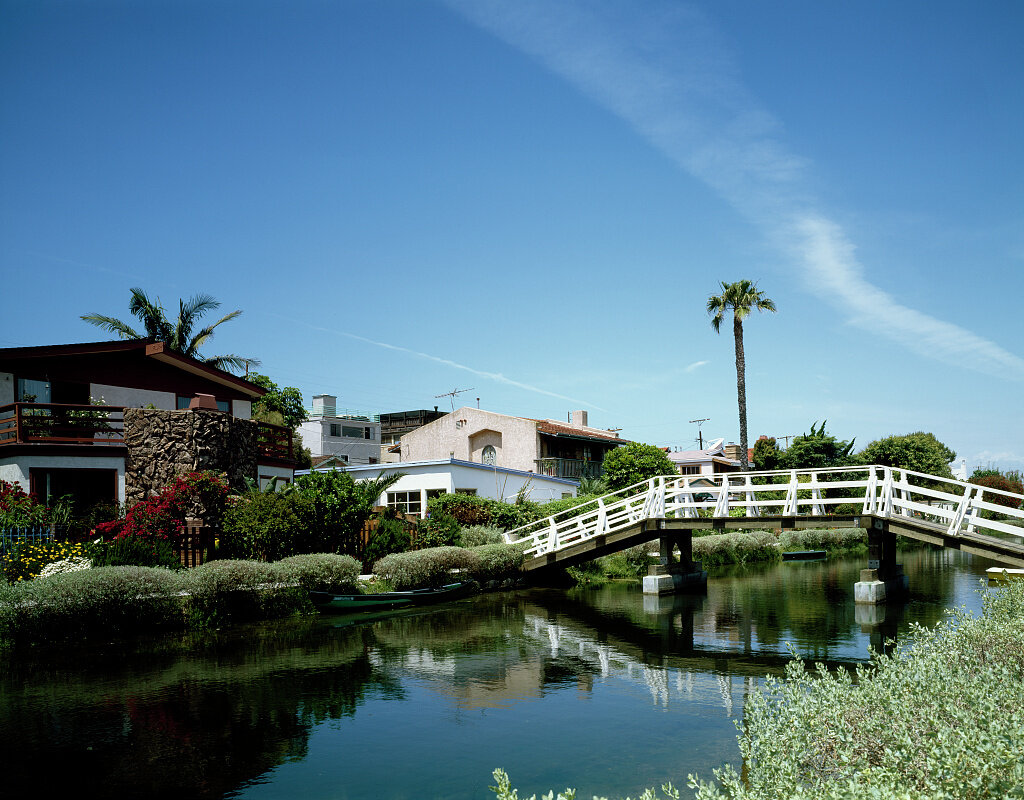
The restored Venice canals. Photo by Carol M. Highsmith, Library of Congress. No known restrictions on publication.
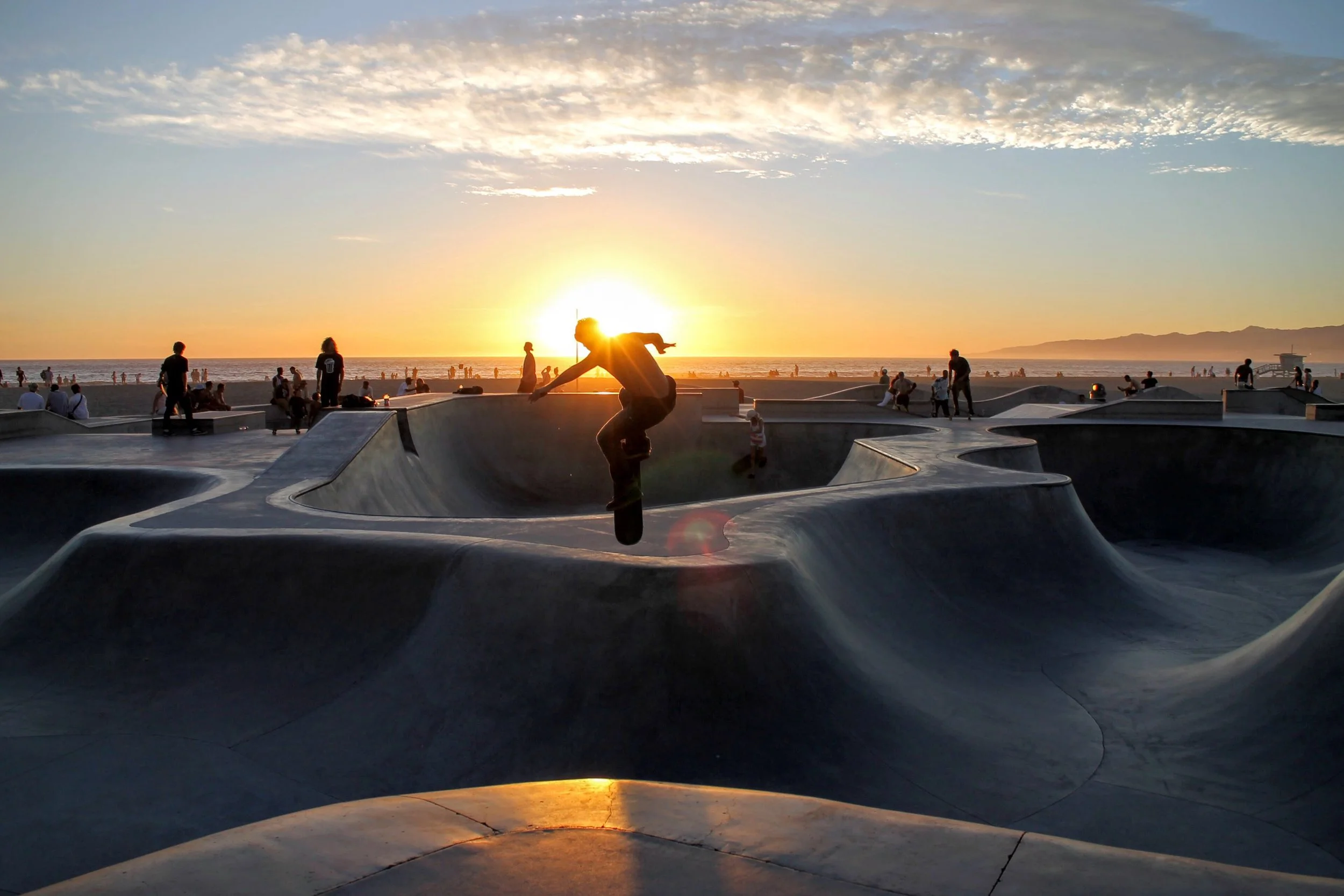
Venice Beach Skatepark, opened in 2009 on the site of the Pit, photographed in 2015. Photo by Matteo Paganelli, CC0, via Wikimedia Commons.
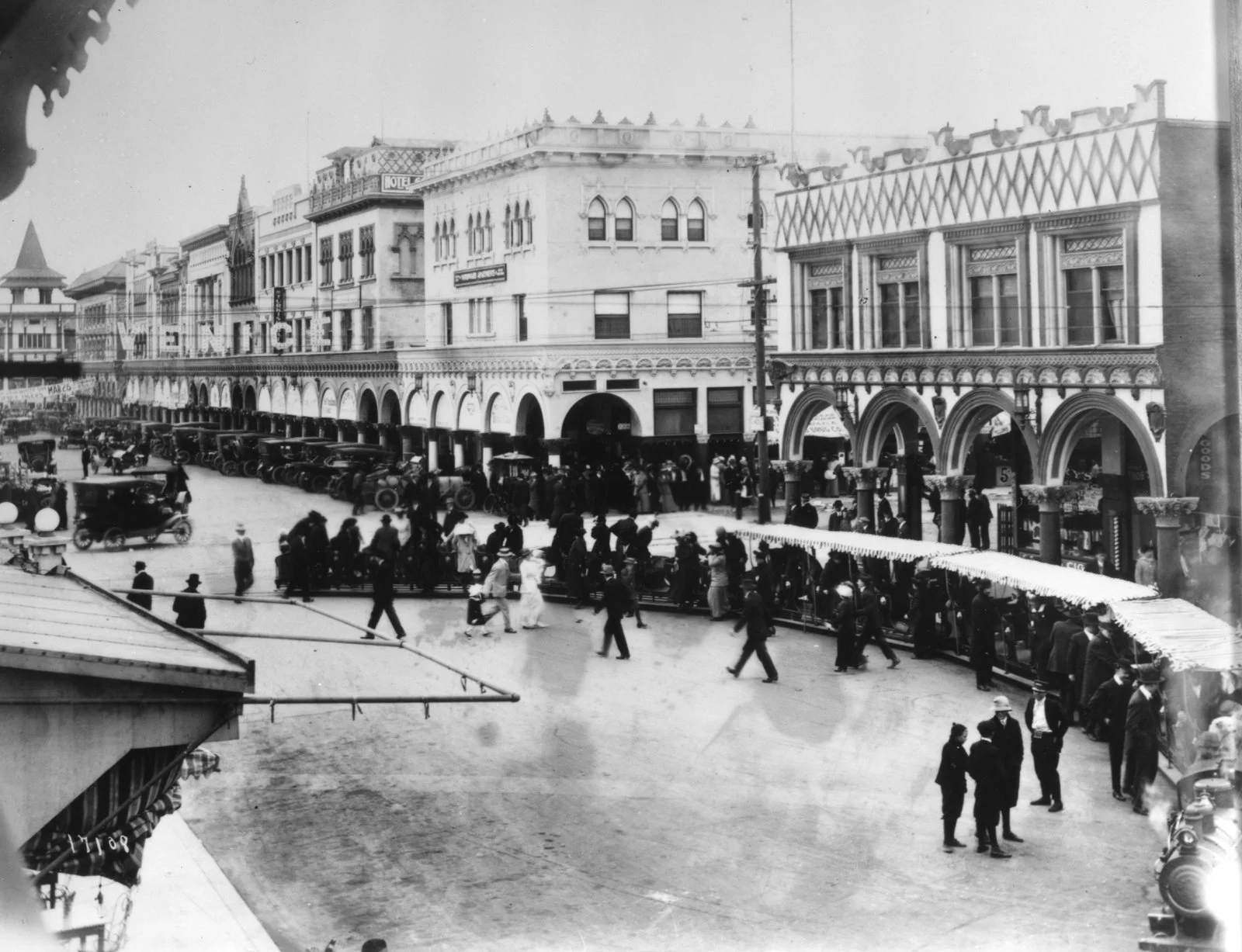
The Venice Miniature Railway on Windward Avenue, looking west toward the ocean, early 20th century. Public domain, via Wikimedia Commons.